 Amazon Connect Analytics
 Salesforce Service Cloud Analytics
 Customer Journey Analytics
 Agentic AI Analytics
 Zoom Analytics
 Back
Back
Picture your Q3 budget review, board update, or AI vendor renewal conversation. Someone in the room asks the million-dollar CX question: is your AI investment actually paying off?
Ever prepared, you present your numbers. Your deflection rate is up. Interactions handled by AI are rising. But what does that actually mean for the business?
It’s a question many CX leaders have struggled to answer when it comes to AI.
A survey of 200 CFOs found that 66% expected significant AI ROI within two years. Yet only 14% say they're seeing meaningful value today. This isn’t an AI capability failure. It's an AI measurement model failure.
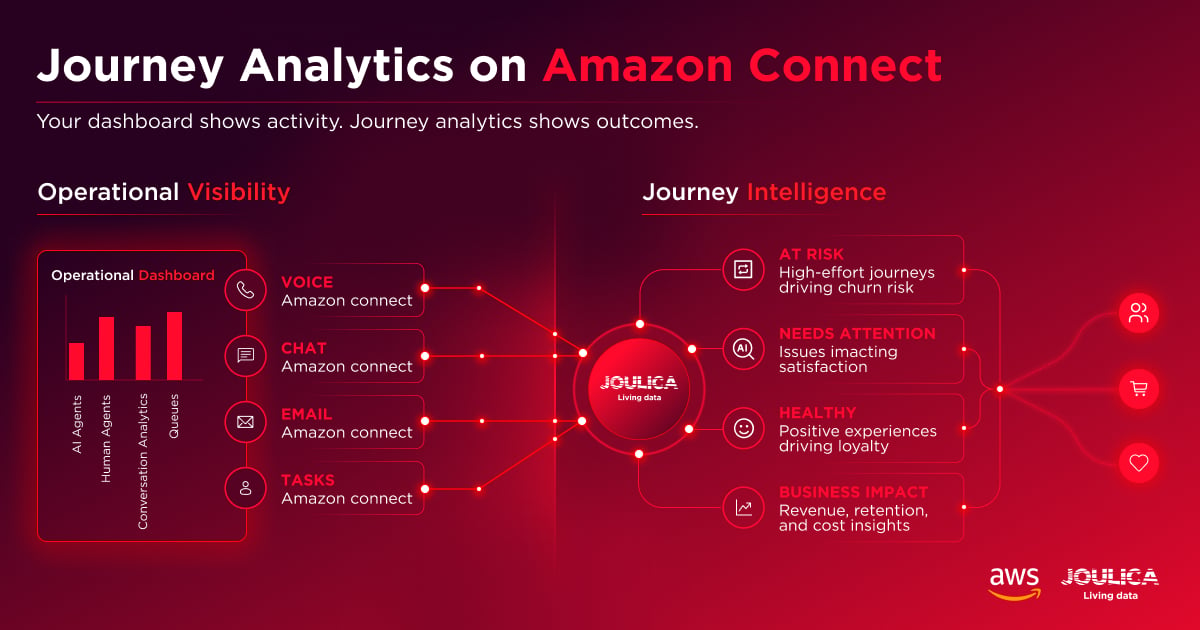
Activity metrics tell the business what the AI did, not its worth.
Why activity metrics don’t land
Deflection rate. Interactions handled. Containment rate. These are AI activity metrics. They measure what the AI did. But executives speak in outcomes. Lead with customer effort, repeat contacts, CSAT, and journey improvements, the measures CX leaders live in, and connect them upward to: revenue, risk, and retention.
Executive teams care about the “so what” and “why” behind your numbers more than anything else. For example, your 68% deflection rate sounds impressive…until you’re asked the obvious follow-ups:
- What was the outcome for the 68% of customers that were deflected?
- Did they resolve their issue, or just stop trying?
- Did they call back an hour later?
- Did they churn quietly three months later?
Without the associated outcome data, your deflection rate isn't a business metric. It's a shiny operational count dressed up as a business outcome.
These executive leaders aren’t being difficult. They're asking the right question, but for most CX leaders, it’s not an easy answer. A 2025 S&P Global analysis found that 42% of companies abandoned most of their AI initiatives, up from 17% the year before.
While a variety of factors are at play, a major one is the inability to prove and communicate business impact. Most CX analytics stacks can’t provide the proof needed to keep a project alive beyond the pilot stage.
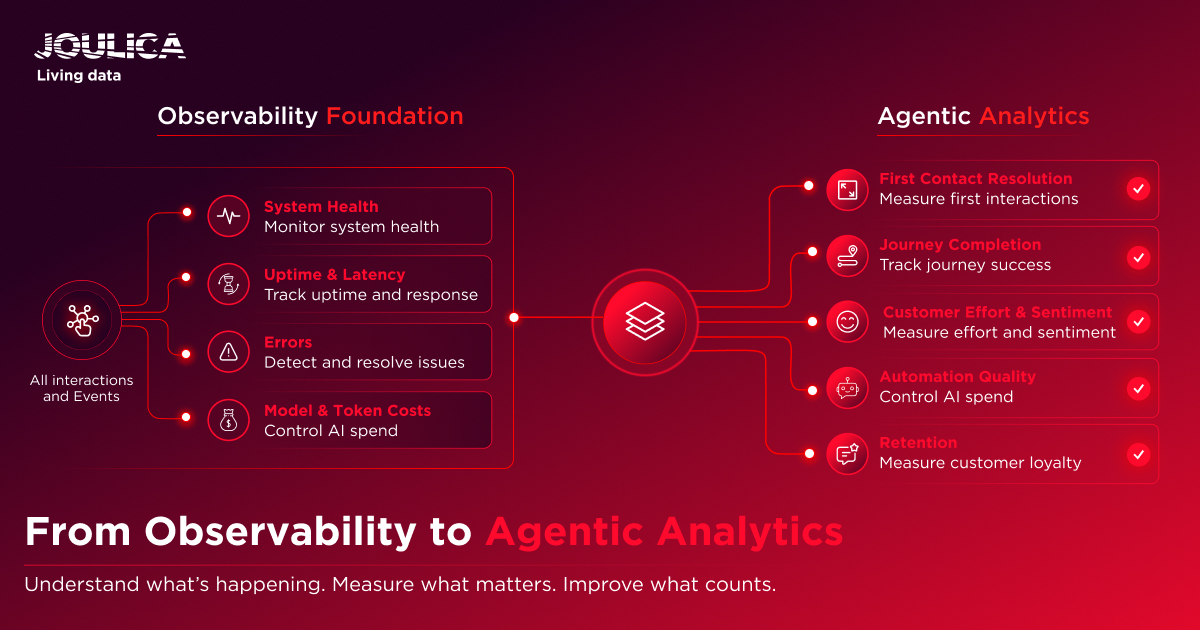
That’s where Agentic Analytics comes into play. It isn't just about AI reporting or QA for bots; it’s about unlocking the massive financial potential of autonomous CX.
The KPIs that matter are the ones that connect AI decisions to customer outcomes. It’s all about quantifying business value, reducing risk, and protecting customer loyalty. Agentic Analytics enables you to answer questions like “Is AI improving outcomes or just containing frustrated customers?” with real data.
If you’re struggling to measure AI business outcomes today, you're not alone. But with Agentic Analytics, you now have a way to close it. Our Agentic Analytics KPI Framework shows you how.
The AI To Impact Linkage Model
Most CX teams are missing a linkage model: the ability to translate AI performance into business outcomes. Our Agentic Analytics KPI Framework organizes AI measurement into five tiers from decision visibility up through governance.
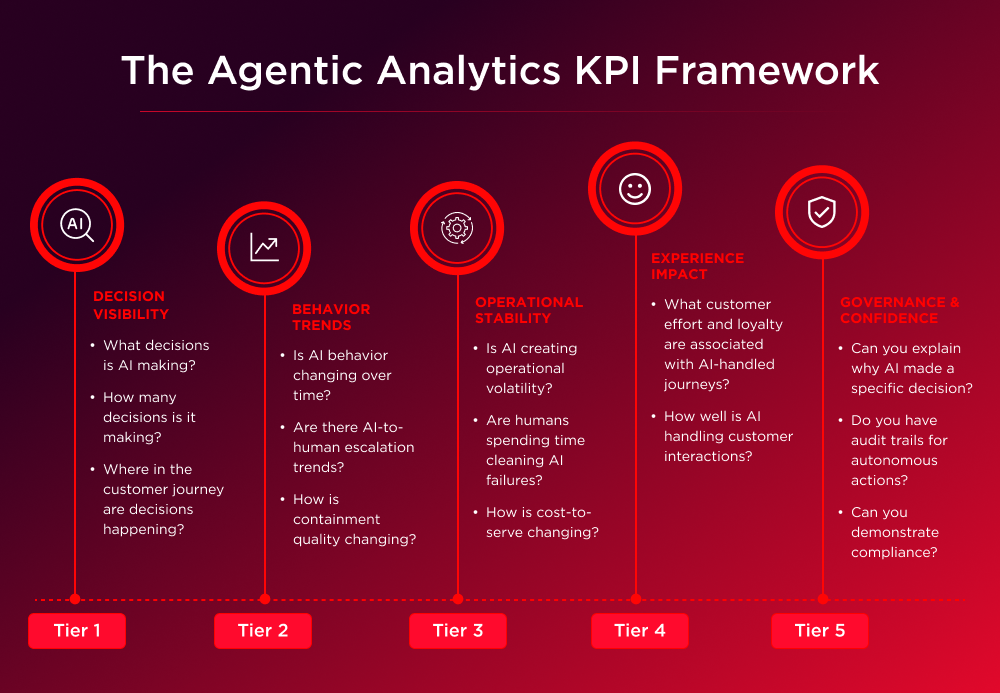
The four metrics below translate the framework's Experience Impact tier into the language finance leaders act on. Each is interconnected and critical to proving the value your AI creates.
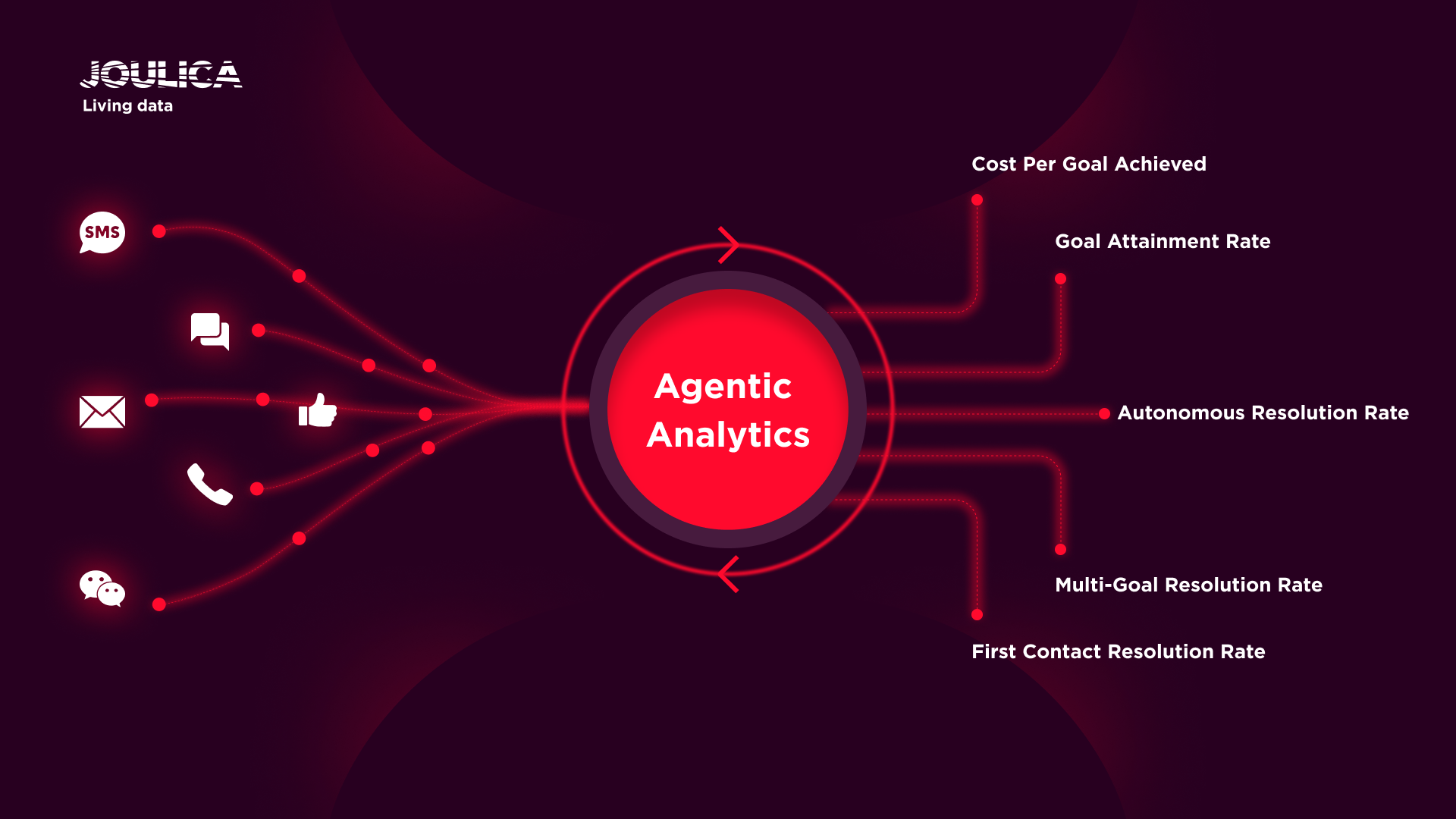
- AI handling rate: the share of interactions the AI handles end to end, including full multi-turn conversations, without a human stepping in.
- This tells you whether the AI is actually attempting to resolve the issue or just deferring to a human, a callback, or a second attempt.
- It connects directly to resolution rate.
- Autonomous resolution rate: the percentage of customer issues fully resolved with no repeat contact, on any channel, by AI without human intervention.
- This tells you how much work the customer had to do to reach an outcome, however it got resolved.
- It connects to customer effort score.
- Customer effort score: the amount of effort a customer has to exert to resolve an issue or fulfill a request.
- This tells you whether AI is improving the experience across every interaction, or quietly degrading it.
- It connects to NPS and CSAT.
- Journey revenue impact: completed journeys (funded applications, finished onboarding, closed orders) attributable to AI-handled interactions.
- This tells you whether AI-handled interaction quality is showing up in who stays and who leaves.
- It connects to churn and retention.
Most contact centers already have the raw material for these metrics. The problem is, these data points are usually locked in different systems that have never been introduced to each other or don’t speak the same language.
What most contact centers are missing is the analytics layer that connects the dots and helps teams climb the ladder in near real time.
The Three Metrics That Matter to Executives
Every KPI across every tier earns its place in the framework. Task resolution time, escalation rate, effort score: they all tell you something real about how your AI is performing and what it's doing to the business. But when the conversation turns to ROI and finance, three metrics carry the conversation. They're the ones your board, CIO, or CFO will actually act on.
1. Cost per resolved interaction
Note that this is NOT cost per contact. A high-deflection AI system can look incredibly cheap on a per-contact basis while quietly generating many repeat contacts. It's the same trap as the 68% deflection rate we mentioned earlier. Your cost-per-contact metric can look great until you ask what happened afterward.
Cost per resolved interaction, however, ties directly to the outcome. It tells you how much it costs to actually fix the customer's problem. That's the outcome-vs-activity distinction your executive team cares about.
2. NPS or CSAT delta attributable to AI-handled interactions
This isn't the same as watching your overall CSAT score trend up after deploying AI. Aggregate sentiment can move for a dozen reasons that have nothing to do with your AI: a product fix, a seasonal dip in ticket complexity, a new hire who's a great communicator. If you can't isolate AI's contribution, the number is just a coincidence.
The delta is what makes this KPI credible. Map CSAT and NPS to the paths the AI agent took to resolve the customer's problem. The delta by path shows you exactly which paths to fix, not just whether AI 'helped' in aggregate.
3. Journey Outcome correlation
This KPI asks the question Tony's framing puts at the center: does the use of AI along the journey correlate with better journey outcomes? Every journey exists to produce something: a completed mortgage application, a finished onboarding, a renewed contract, a loyal member. Compare journeys where AI handled key steps against journeys where it didn't, and measure whether the outcome the journey exists for actually happened more often. Tying AI participation to journey completions and customer lifetime value lets you quantify exactly how much value AI is creating, not in interactions handled, but in journeys that ended the way the customer and the business needed.
There aren’t new metrics. They're existing business metrics mapped to AI behavior, and that mapping is exactly what the Agentic Analytics KPI Framework provides. Without it, your business questions remain unanswered, no matter how well your AI is performing.
Build the Case for AI Today
Ultimately, proving ROI on agentic AI isn’t that hard. It all comes down to readiness. The teams that can answer it today didn't do anything earth-shattering. They built the measurement layer before the board started asking, not after.
Joulica connects AI performance data to business outcome data at the frequency and granularity finance and executive leaders trust. And our new playbook, Moving Beyond Agentic Observability, lays out that measurement layer in full: how to connect AI behavior to revenue and the business case for going further.
You might be halfway through your fiscal year, but that doesn’t mean it’s too late to make the case for building your AI measurement layer. Q3 is the perfect time to close the gap, while you still have a full quarter to do it.
If you’re having this conversation soon, now’s the time to get ready, and our team can help. Schedule a short discovery call with one of our experts today to get started on your agentic analytics business case.