 Amazon Connect Analytics
 Salesforce Service Cloud Analytics
 Customer Journey Analytics
 Agentic AI Analytics
 Zoom Analytics
 Back
Back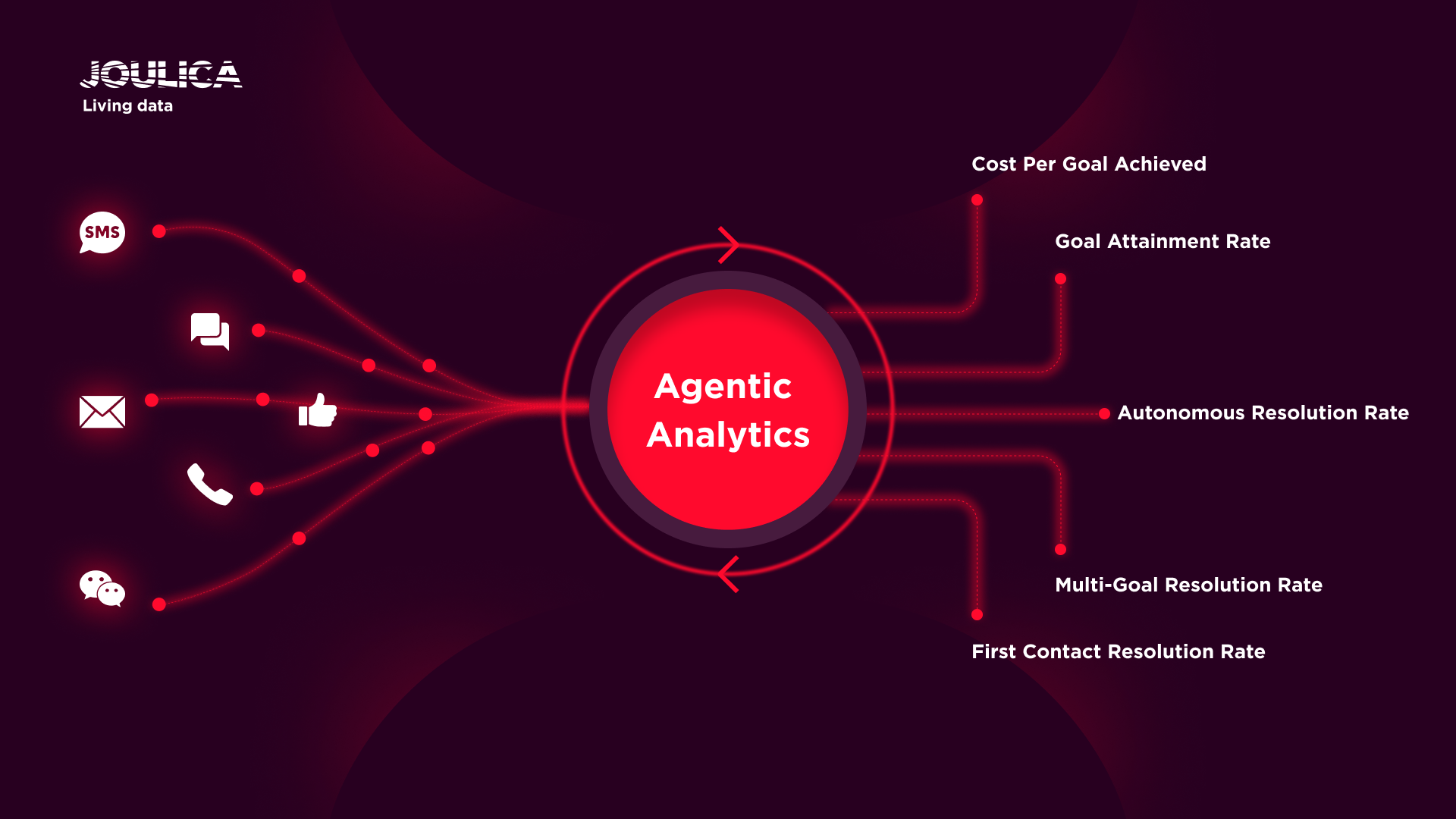
79% of organizations have adopted Agentic AI or AI agents in some capacity.
75% of executives believe “AI agents will reshape the workplace more than the internet did.”
80% of routine customer service inquiries will be autonomously resolved by agentic AI by 2029.
These stats are staggering, jaw-dropping, and unprecedented. They prove that AI is no longer experimental. It’s making decisions that affect cost, retention, and brand reputation in real time.
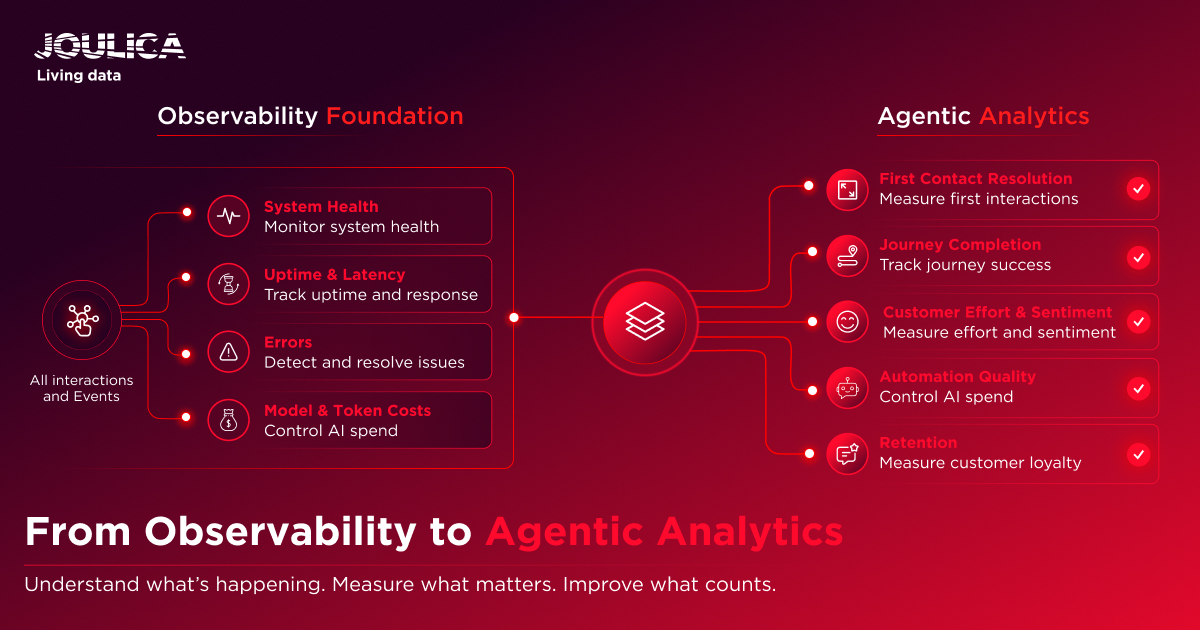
However, as we discussed in our last blog, too many CX leaders are on the back foot when it comes to understanding what AI agents are doing, where they need improvement, and how they’re changing over time. That’s where Agentic Analytics comes in, giving contact center leaders the visibility and insight they need to understand, optimize, and govern their agents.
But every CX leader tasked with proving ROI knows that understanding the “what” isn’t enough. It’s the “so what” that executive teams care about. It’s all about quantifying business value, reducing risk, and protecting margins.
In this article, we move beyond core agentic AI metrics and break down the KPIs that translate autonomous AI behavior into financial impact, operational efficiency, and measurable business value. So you can move beyond “Is it working?” to “What is it worth?”
Agentic AI KPIs That Translate to Business Value in the Contact Center
Every budget proposal or investment request has a section on expected business value or ROI for a reason. When leaders approve funding, they’re not just buying technology; they’re investing in a measurable outcome. They’re trusting you to deliver that return and to prove that it’s happening.
But that’s often easier said than done.
You can feel that things are improving—customers are happier, employees are less frustrated, processes are moving faster, and fewer issues are escalating. There’s momentum. The sense that the investment was worth it.
But none of that matters if you can’t tie it back to dollars and cents. If you can’t quantify the impact, demonstrate the return, and show exactly how the investment is driving business value, it becomes much harder to justify the spend, let alone secure the next one. As Agentic AI moves into production environments, leaders must shift from monitoring outputs to evaluating decision quality over time.
Your agentic AI investment in the contact center is no exception. That’s why Agentic Analytics isn't just about AI reporting or QA for bots; it’s about unlocking the massive financial potential of autonomous CX.
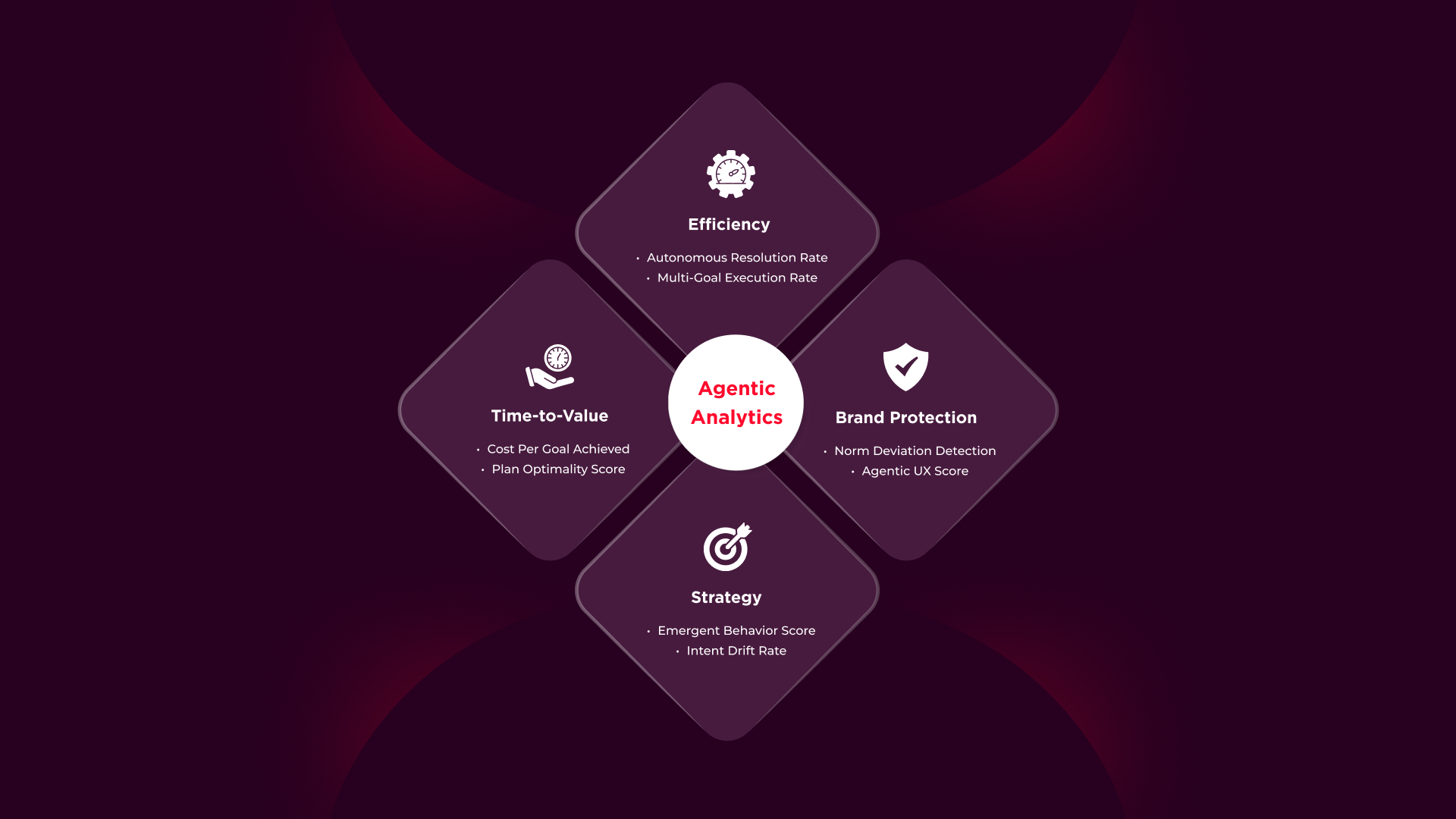
Accelerating Time-to-Value
We live in a world of instant gratification, conditioned to expect immediate results. But anyone who’s lived through a new technology implementation knows achieving ROI takes time. The key is to get there as quickly as possible.
According to the 2025 IBM CEO study, “only 25% of AI initiatives have delivered expected ROI over the last few years, and only 16% have scaled enterprise-wide.” Ouch. Something tells us those leaders were hoping to see a return much more quickly. So what’s the holdup?
A leading cause is likely adoption. Many AI deployments often stall in "pilot purgatory" because stakeholders don't trust the black box. In fact, Prosci’s 2025–26 research shows 63% of organizations cite human factors, such as resistance, uncertainty, and lack of alignment, as a primary challenge in AI implementation, not the tech itself.
Agentic Analytics helps overcome that challenge. It gives your teams deep visibility into agentic performance, reducing doubt and developing trust in agents’ actions much earlier. This enables your business to move agents from beta to full production faster, realizing automation savings months earlier than your competitors.
Agentic Analytics also helps you accelerate time to value by shifting AI from something you hope is working to something you can prove is working, and by optimizing quickly where needed. Relevant Agentic Analytics KPIs include:
Cost per goal achieved
- What it is: Proves value immediately by showing you exactly what it costs to resolve an issue or complete a task with agentic AI, and how that compares to a human-handled interaction.
- Why it matters: Cost per goal achieved quickly answers the most important executive question: “Is this saving or making us money?”
- How it accelerates time to value: Since you can see value per interaction from day one, you can quickly identify high-value use cases and double down on them.
Plan optimality score
- What it is: Measures the optimal path to each solution.
- Why it matters: Plan optimality score answers: “How close are we to maximum possible efficiency, and how quickly can we get there?”
- How it accelerates time to value: Shows how efficiently the AI is solving problems, not just whether it succeeds. This enables teams to pinpoint where agents take longer paths and fix them quickly—shortening the ramp-up period between deployment and peak ROI.
Optimizing costs without sacrificing CSAT
In the contact center, every second counts. Shaving a minute off a single interaction may feel like a drop in the bucket, but multiplied across thousands of conversations a day, it adds up to massive time and cost savings by year’s end. Better yet, the greatest savings come when human agents aren’t involved at all.
Cost containment and efficiency are the primary promises of AI agents: delivering smooth, personalized, human-like customer experiences without growing headcount. To realize that promise, CX leaders need to measure and continuously optimize how efficiently their agents achieve outcomes.
Agentic Analytics identifies the exact moment an autonomous agent becomes inefficient—for example, taking too many steps to solve a simple problem. By tuning these “goal paths,” organizations can shave seconds off millions of interactions, dramatically reducing compute and operational costs while keeping customers happy. Relevant Agentic Analytics KPIs include:
Autonomous resolution rate
- What it is: The percentage of customer issues fully resolved by AI without human intervention.
- Why it matters: It ensures you’re reducing cost by removing effort, not by denying service. It decouples growth from cost, enabling revenue and volume to grow 10x while support staff remains flat.
- How it optimizes costs while maintaining CSAT: Each autonomous resolution replaces a human-handled interaction that would cost dollars instead of cents. When your autonomous resolution rate is high and outcomes are successful, customers benefit from instant resolution, no transfers, and 24/7 availability.
Multi-goal execution rate
- What it is: Tells you how well AI completes multiple customer needs in a single interaction—for example, handling a refund, updating an address, and scheduling a callback simultaneously.
- Why it matters: Solving three problems in one interaction is better for customers (fewer repeat contacts) and far cheaper than three separate contacts.
- How it optimizes costs while maintaining CSAT: This metric drastically reduces average handle time (AHT) and friction, resetting customer expectations for how quickly service should be delivered.
Creating an agentic feedback loop to drive strategy
Customer interactions are brimming with customer signals that can help inform your CX, product, and digital experience strategies. CX teams are usually the first to hear customer feedback on new products and services, marketing campaigns, and more—making them an invaluable resource for other functional decision-makers.
However, too often, those signals are missed or never bubble up to those teams. With everything else on their plates, human agents often forget to log customer complaints or overlook emerging trends.
Agentic Analytics captures every deviation and intent shift in real-time. Product and marketing teams can then use these insights to identify new revenue opportunities or market shifts before competitors do.
Relevant Agentic Analytics KPIs include:
Emergent behaviour score
- What it is: Measures how often your AI independently discovers new, more efficient, or more effective ways to achieve goals.
- Why it matters: This metric helps you close blind spots, fuel continuous innovation, and keep you ahead of the competition.
- How it drives strategy: Instead of relying on periodic process reviews, AI can quickly identify, validate, and scale better ways of working.
Intent drift rate
- What it is: Measures how often conversations shift from the original intent to something new or unexpected.
- Why it matters: You gain real-time visibility into how customer behavior is evolving so you can adapt faster.
- How it drives strategy: Old bots break if the customer changes the subject or asks a clarifying question. Intent drift rate helps you identify gaps in your current strategy, such as confusing processes or emerging customer needs, and highlights new automation opportunities.
Protecting brand equity in an autonomous world
A top concern amongst data leaders is that agentic AI will act in ways that put their brand and customers at risk—and their concerns aren’t unfounded. One hallucination can go viral, tarnishing your reputation and irreparably eroding customer trust.
But the best leaders aren’t letting fear stand in the way of progress. Instead, they’re safely adopting agentic AI using robust monitoring and guardrails. This is where AI governance becomes operational, not theoretical. Agentic Analytics can be a foundational piece of your risk mitigation strategy, catching compliance issues and policy violations in real time. Measuring agentic AI’s performance through a security and compliance lens ensures you adopt technology while protecting revenue leakage, customer confidence, and brand reputation because AI should be your best employee, not your biggest liability.
Relevant Agentic Analytics KPIs include:
Agentic UX score
- What it is: Measures how easy, helpful, and satisfying it is for customers to interact with AI agents.
- Why it matters: Customer effort is a leading indicator of overall customer satisfaction. High agentic UX scores reflect easy, positive experiences that drive loyalty.
- How it drives brand equity: Makes your AI agents a marketing asset: customers choose your brand over the competition because you’re so easy to deal with.
Norm deviation detection
- What it is: Measures how often an AI agent’s behavior falls outside expected patterns, signaling potential risk or inconsistency.
- Why it matters: Creates a "self-healing" operation where risks are neutralized automatically, securing and protecting brand reputation 24/7.
- How it drives brand equity: The system flags "weird" or risky behavior instantly, before it impacts the customer.
Delivering hard ROI to leadership
The industry has been talking about transforming the contact center from a cost center to a value generator for years. And while some CX organizations have successfully shifted that perception, many still struggle to justify their worth. That’s because tying revenue to CX initiatives, especially at the agent level, has historically been challenging outside of pure sales environments.
It’s time to stop extrapolating your contribution from indirect metrics and prove value per agent. Agentic analytics enables you to report exactly how much revenue an agent preserved or generated.
Relevant Agentic Analytics KPIs include:
Goal attainment rate
- What it is: Measures how often AI agents successfully achieve an interaction’s intended business outcome, not just whether a ticket was closed, but whether the right goal was achieved.
- Why it matters: AI agents consistently pursue high-value goals, creating a strategic CX engine rather than a reactive fix-it shop.
- How it proves hard ROI: Reporting goal attainment rate per agent or per interaction enables you to directly attach a dollar value to AI agent activity. If an AI agent retained a customer worth $2,000 in annual recurring revenue, that is not an extrapolation, it is hard revenue impact.
First contact resolution (FCR)
- What it is: The percentage of customer issues fully resolved by an AI agent in a single interaction.
- Why it matters: The more interactions AI agents resolve the first time, the lower the customer frustration and the lower the likelihood of churn.
- How it proves hard ROI: Tying first contact resolution (FCR) rates to customer lifetime value data enables you to quantify exactly how much recurring revenue your agentic AI is protecting by eliminating the friction that drives customers away.
Agentic visibility is your competitive advantage
In the race for AI dominance, the winners won't just be those with the smartest agents. They’ll be the ones with the clearest vision of what those agents are doing using Agentic Analytics in the contact center.
Joulica Agentic Analytics enables you to correlate agentic AI’s behavior with business outcomes and the customer journey. Holistically understand how agentic AI impacts your cost-to-serve, containment sustainability, repeat contact rates, and other critical CX outcomes.
Start measuring for value, not volume.
Are you ready to see what Agentic Analytics can do for you?
Contact us at Joulica.io to discover more best practices for measuring and optimizing your customer journeys.