 Amazon Connect Analytics
 Salesforce Service Cloud Analytics
 Customer Journey Analytics
 Agentic AI Analytics
 Zoom Analytics
 Back
Back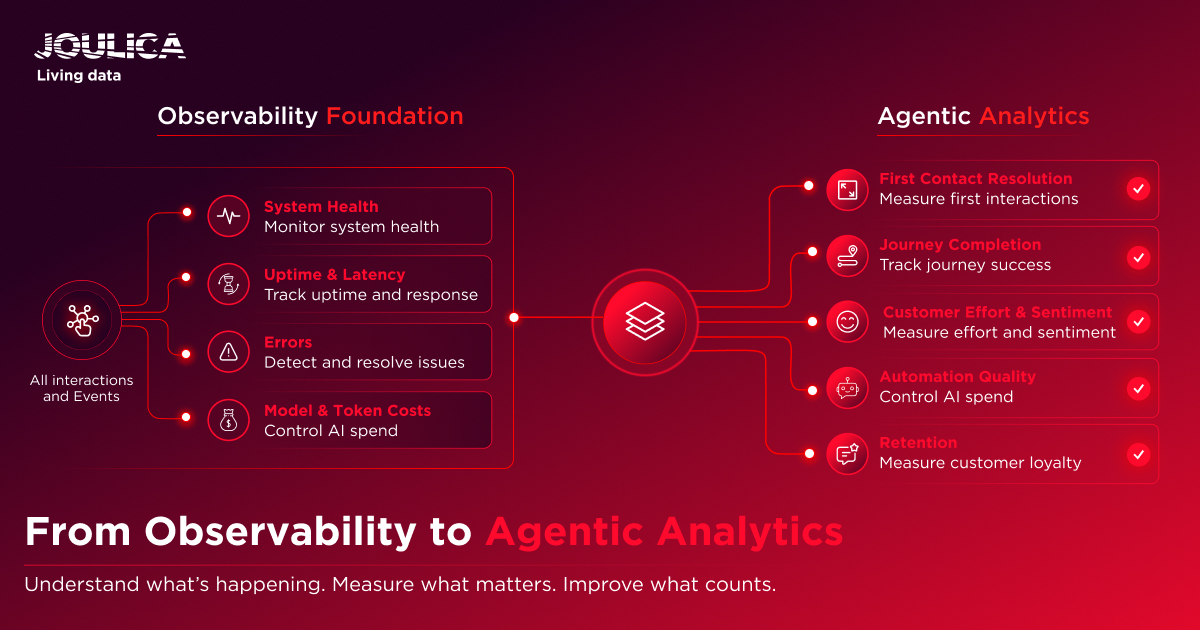
CX leaders deploying agentic AI all want one key thing: confidence that it is helping their customers. They want to know the technology is healthy, and they want to know it is actually making experiences better.
Most teams can answer the first half of that today. Pre-deployment testing and post-deployment observability tell you whether your AI systems are working as built. They are essential. Agentic AI raises a second question that sits right alongside the first: is the AI actually delivering a better customer experience? Answering that means connecting what the AI decides to what the customer experiences. That connection is agentic analytics, and it is the missing link between a healthy system and a customer journey you can stand behind.
Let’s look at how the two fit together.
Observability Is the Foundation
Observability grew out of IT infrastructure monitoring: system health, latency, error rates, and related signals. According to Gartner, Inc., Critical Capabilities for Observability Platforms (2025), "their core function is to help I&O teams proactively monitor, analyze and optimize application health and performance." In modern AI environments, that now extends to tracking token usage, model calls, and the costs that come with them, which helps teams understand and contain spend.
These capabilities are essential. They are table stakes for any serious AI deployment, and any credible agentic strategy builds on them. Observability answers a specific, important question: is the system performing as expected?
Agentic AI introduces a second question that lives next to that one: are customers succeeding across the journey? A VP of customer experience and an I&O engineer look at the same deployment through different lenses. One needs to know the tech stack and the model calls are healthy. The other needs to know whether AI-handled interactions are resolving issues, and whether a customer who moves from a chatbot to a live agent feels a connected experience or has to start over.
Both questions matter. They simply call for different instruments.
The New Question Agentic AI Creates
Here is what makes agentic AI different. It does not just execute a script. It makes autonomous decisions, in real time, across channels, vendors, and touchpoints. That is a genuinely new capability, and it creates a genuinely new measurement need.
Consider a single day in an agentic system. Your tools can confirm it processed 1,000 interactions without errors. The harder and more valuable question is what those interactions did for customers: how many resolved on the first try, how many customers abandoned self-service and called back, and where friction crept into journeys that crossed multiple channels.
Those answers do not live in system logs. They live in what happened after the AI agent responded: whether the issue got resolved, whether the customer stayed or left, whether they called back, whether trust was built or eroded. Capturing them takes journey-level measurement that spans vendors, channels, and interaction types. This is new territory. The analytics stack most teams have today was built for a world where people, not AI, made these decisions, so the need is real and largely unmet across the market.
What Agentic Analytics Adds
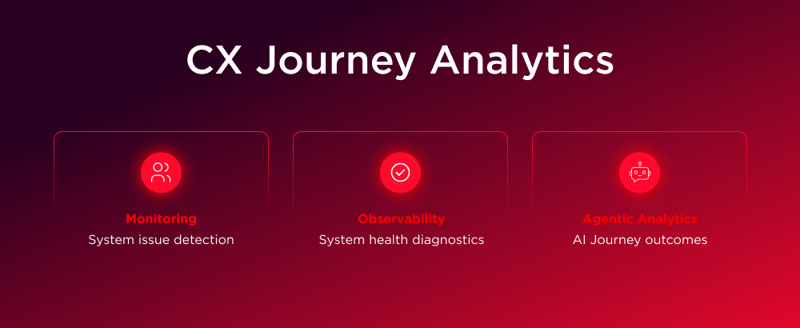
A complete view of an agentic deployment covers both halves of the picture: whether the systems are working technically, and what those systems are doing for customers. The first half is monitoring and observability. The second is agentic analytics.
Agentic analytics connects AI decisions to journey outcomes in real time. It ties autonomous AI behavior to the metrics CX leaders are measured on: retention, sentiment, first-contact resolution, automation quality, and journey completion.
Alongside uptime and technical performance, agentic analytics helps you confidently answer questions like:
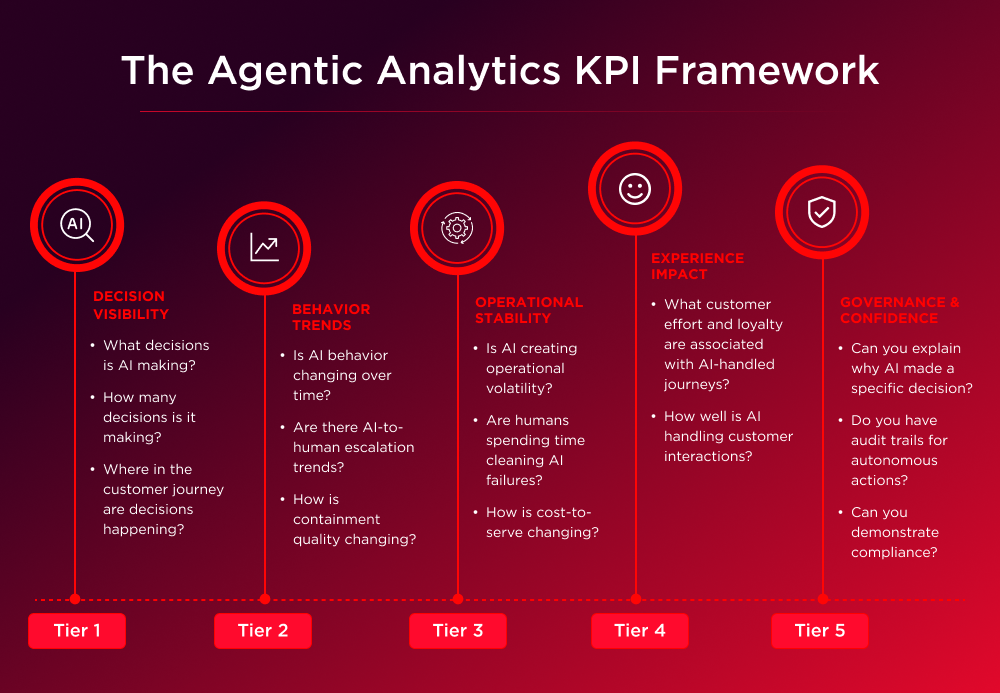
- What decisions is the AI making, and where in the journey are they happening?
- How is AI behavior changing over time, and why is the AI making a given decision?
- Did a customer routed to self-service by an AI agent resolve the issue, or abandon and call back?
- What is the customer effort and loyalty associated with AI-handled versus human-assisted journeys?
- Where do customers hit friction in journeys that cross multiple channels, including AI touchpoints?
These are journey-level questions. Answering them is what turns a working system into a customer experience you can trust.
The Measurement Gap Is Widening
Agentic AI is no longer experimental. It is a business reality, and it has scaled remarkably fast. Analytics and governance practices are now catching up to that pace, and the gap between how much AI organizations deploy and how well they can measure it is widening across the industry.
The data bears this out. According to audit and advisory firm Grant Thornton, many organizations are "scaling AI they cannot explain, measure, or defend." The firm's 2026 AI Impact Survey found that 78% of surveyed organizations lack strong confidence that they could pass an independent AI governance audit.
For CX leaders, closing that gap means being able to answer three basic questions about any agentic deployment: what is the system doing, how well is it doing it, and how is it affecting business outcomes. Observability covers the health of the system. Agentic analytics covers the other two.
From Foundation to Outcomes
CX leaders are right to be optimistic about agentic AI. Capturing its full value takes more than deploying the technology and confirming the systems are healthy. It takes understanding how those systems behave inside real journeys, tuning their decisions, and connecting AI actions to business results.
That is where Joulica Agentic Analytics comes in. It supplements your observability investment and moves beyond surface-level AI metrics to show how agentic systems behave inside real customer journeys.
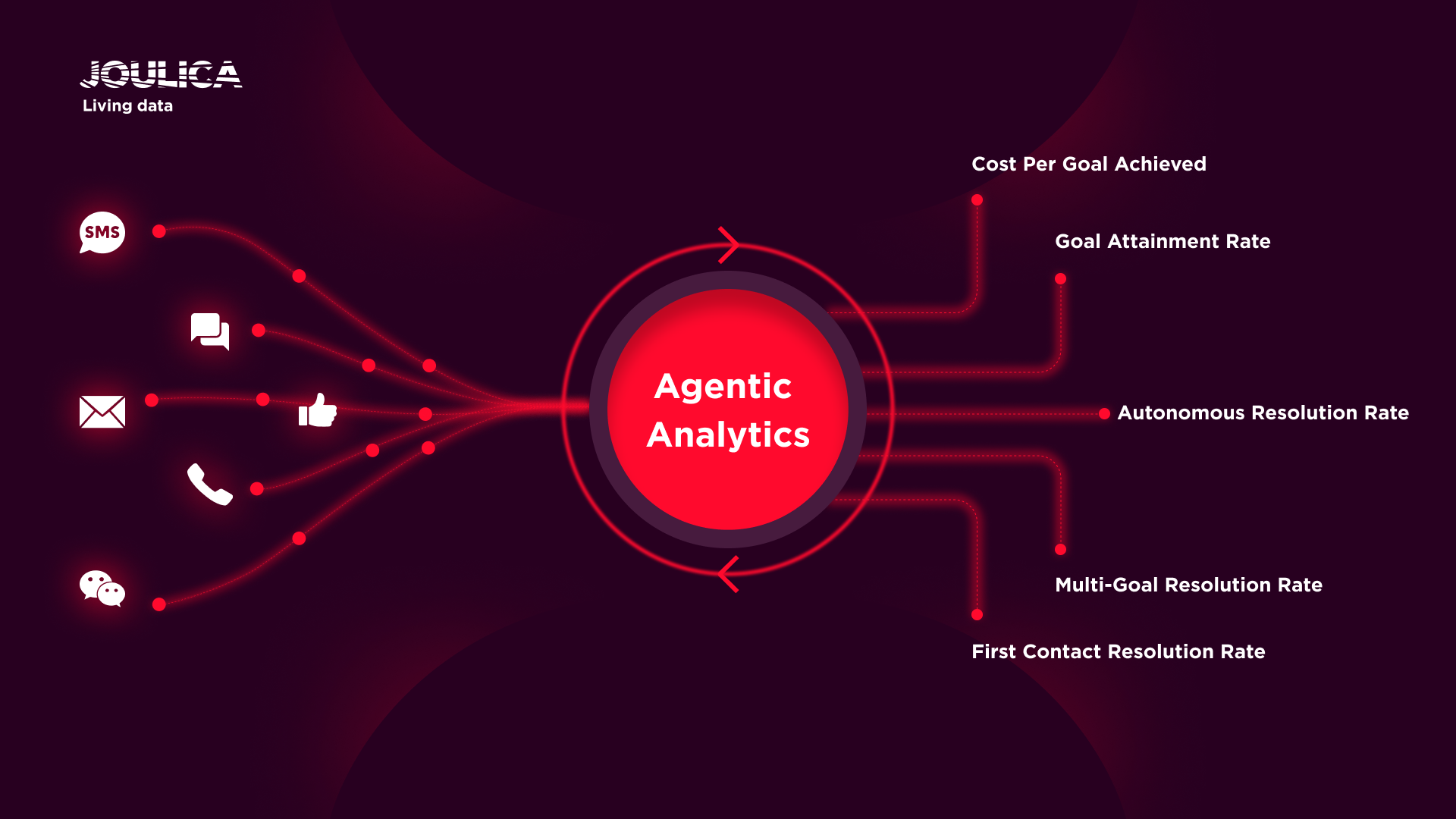
Joulica's five-tier Agentic Analytics KPI Framework (sneak peek below) helps teams measure more than technical performance. It translates autonomous AI behavior into financial impact, operational efficiency, and measurable business value.
Download our new Moving Beyond Agentic Observability playbook today for the complete framework, plus a 90-day Agentic Analytics Action Plan with 10+ hands-on planning and assessment exercises, and real-world agentic analytics examples and use cases.